
A patient can leave a clinical encounter with accurate instructions, a prescription, printouts, a follow-up plan—and a head full of questions they did not ask.
Some questions arrive only after the patient gets home.
- What will this diagnosis mean for everyday life?
- How should I explain it to my family?
- What if I cannot manage the treatment?
- What am I supposed to do first?
The care team may have provided everything required during the visit. But the patient is no longer in the clinical setting. They are processing fear, cost, transportation, family responsibilities, medication concerns, and unfamiliar clinical language in the middle of real life.
That is where continuity becomes vulnerable.
Health systems cannot add another clinician to every patient's kitchen table. They can, however, extend the patient conversation beyond diagnosis or discharge with education that feels human, responds to patient concerns, and points back toward an appropriate next step.
The opportunity looks different from each side. Healthcare agencies can turn governed patient education into a new client channel. Health systems can extend understanding and empathy after clinical encounters. Both are applications of the same platform: conversations that respond to what patients need in the moment.
Information delivered is not the same as understanding achieved
Healthcare facilities are full of patient-education material. Some of it is excellent. Yet brochures are left behind, discharge packets go unread, and portals contain more information than a worried patient knows how to navigate.
The limitation is not necessarily the quality of the content. It is the mismatch between how information is organized and how patients experience a new condition.
AHRQ’s Health Literacy Universal Precautions Toolkit similarly emphasizes structuring health information and services so people can understand and use them.
Patient education is organized around subjects: Understanding Diabetes. Medications. Nutrition. Blood Sugar. Complications.
Patients have immediate questions that are shaped by their life circumstances: Can I afford this medication? What can I eat tonight? Can I keep working? What do I tell my family? Is this going to get worse?
The priority changes from person to person. A financial concern may come first for one patient. Fear may dominate for another. Family responsibilities, work, food, transportation, symptoms, or treatment may take precedence.
Emotion determines what the patient is ready to hear. A patient who is overwhelmed may not search a library, watch a long video, or read a literature packet to locate the one response that will help them move forward.
A conversational experience begins somewhere different: with what is top of mind for the patient.
The vulnerable space between the plan and the next step
The path out of care is rarely a single decision. It can be a gradual loss of momentum:
Where continuity can weaken after the visit
- Diagnosis or dischargeThe patient leaves with instructions and a clinical plan.
- Real life intervenesQuestions and practical barriers emerge outside the clinical setting.
- Uncertainty compoundsThe patient delays a prescription, appointment, or recommended action.
- The connection weakensThe care team may not know what prevented the next step.
- The patient returns laterThe condition may be harder and more costly to manage.
No educational tool can eliminate every clinical, financial, transportation, or social barrier. It should not claim to. But a health system can reduce one source of avoidable friction: leaving patients alone with questions that the organization is capable of anticipating and addressing.
Patient behavior is shaped by upstream drivers of health
CMS now uses “upstream drivers of health” in its Community Health Integration framework—a broader term than social determinants alone. The language recognizes that patient behavior and the ability to follow a care plan can be affected by dietary, behavioral, medical, environmental, and practical factors.
Those drivers often become visible only after the patient leaves the clinical setting. A prescription may collide with cost or uncertainty. A follow-up appointment may collide with transportation or work. A recommendation may collide with family responsibilities, mistrust, or a patient who does not yet understand why the next step matters.
HealthConvos does not resolve those barriers by itself. It can help patients understand the plan, articulate concerns, surface questions for the care team, and find an appropriate next step. That makes it a support layer around whole-person care—not a substitute for the people and services responsible for delivering it.
Supporting CHI work is not the same as billing for it
This distinction matters to revenue-cycle leaders.
HCPCS G0019 covers 60 minutes per calendar month of Community Health Integration services performed by certified or trained auxiliary personnel, including community health workers, under the direction of a physician or other billing practitioner. It is time-based human work. Software does not independently accrue those billable minutes, and HealthConvos should never be represented as doing so.
The defensible role is supportive: HealthConvos reinforces the education, behavioral-change, navigation, and self-advocacy work surrounding a CHI service. A patient can arrive at a human interaction with greater context and better-formed questions. Aggregate intent trends can also show staff where recurring uncertainty is concentrated. Whether any particular activity satisfies billing requirements remains the responsibility of the billing organization and its compliance team.
Empathy is part of how patients make sense of care
Patients need clinical accuracy. They may also need to hear from someone whose experience feels recognizable.

HealthConvos modules are built around characters with coherent journeys through diagnosis, uncertainty, decisions, setbacks, and forward movement. A patient can follow a character from beginning to end or ask a question and receive the part of the story most relevant in that moment.
The characters provide a human frame around governed information. Their stories can acknowledge what the clinical encounter often has too little time to explore: fear, embarrassment, confusion, family dynamics, and the difficulty of turning a plan into action.
That recognition can be emotional. We have seen viewers respond when a character describes an experience that closely matches their own. The value is not celebrity or entertainment. It is the moment when education stops feeling like material written for “patients” in the abstract and begins to feel relevant to this patient's life.
Empathy does not replace medical guidance. It can help a patient become ready to understand and act on it.
A conversation without an open-ended medical chatbot
Health systems are right to be cautious about generative AI producing medical answers for patients.
HealthConvos separates the conversational interface from the response content. A patient asks a question in their own words. AI identifies the intent of the question, but it does not compose a new medical answer. The system routes the patient to a relevant response from a finite library of recorded, governed clips.
Every patient-facing response has a script, video, and caption track available for review. Once approved, that response remains locked. A new patient need becomes a candidate for new reviewed content—not permission for the system to improvise.
The experience can therefore respond conversationally while keeping clinical, legal, and regulatory control over what patients actually see and hear.
It also has a clear boundary: the module renders no medical opinion of its own. Questions outside its approved response set are directed back to the care team or appropriate clinical resources.
Privacy begins with distribution
Patients should be able to seek basic education without being placed into a marketing funnel.
HealthConvos can be distributed through QR codes on provider materials, privacy-appropriate email or SMS links, embeds in webpages, or links from existing digital properties. The best method depends on the setting and the health system's privacy requirements.
QR codes are especially useful because a patient can move directly from a physical resource to a digital experience without a referral domain carrying contextual information. But QR codes are not the only option. The governing principle is to give patients a direct path while minimizing unnecessary disclosure and tracking.
When the condition itself is sensitive, distribution can lead first to a generic landing page. A card, link preview, browser entry, or phone screen does not need to announce why the patient received it.
Privacy is not merely a statement in the footer. It has to shape the path into the experience, the information collected during it, and what remains afterward.
Learn what patients need without learning who they are
Patients deserve access to health information without becoming a marketing profile.
HealthConvos separates insight from identity. Patients ask questions in their own words. The system identifies the intent, delivers an approved response, and discards the original submission.
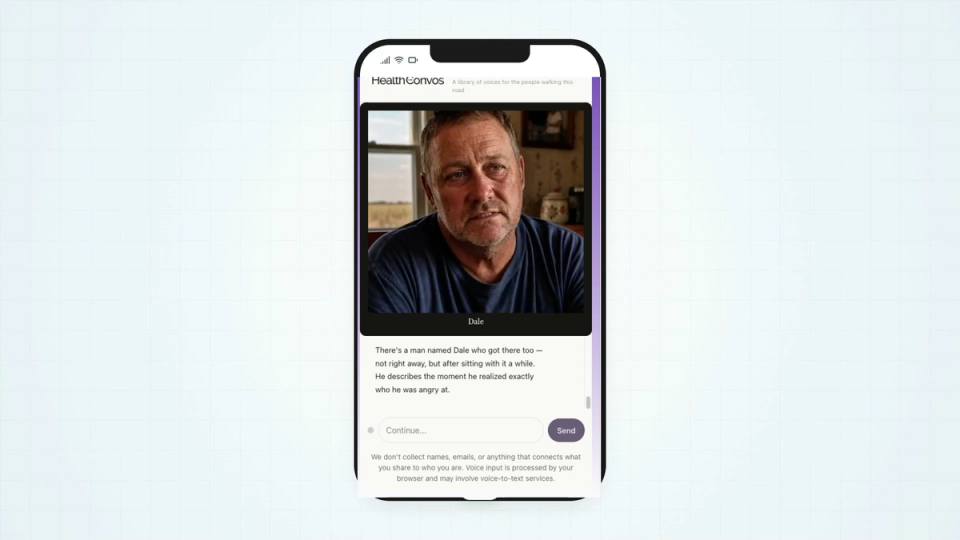
The health system sees aggregate patterns: medication concerns, cost, family communication, side effects, follow-up. It learns what patients need while preserving who they are.
How a private conversation becomes a useful aggregate signal
- Patient questionThe patient asks in their own words.
- Identifying material screenedThe submission is checked before intent processing.
- Intent identifiedAI determines what the patient is asking, not who is asking.
- Governed responseA previously approved video and text response is delivered.
- Aggregate trendNon-identifying intent helps guide future reviewed content.
This aggregate view serves two purposes.
First, it shows where uncertainty remains after the clinical encounter. Revenue, marketing, patient-experience, education, and clinical teams can see patterns that conventional content analytics may miss.
Second, it provides a governed improvement loop. Recurring needs can guide new scripts and stories. Those additions can be reviewed deliberately, recorded, and added to the response library. The module becomes more useful over time without changing approved answers behind the scenes.
One intervention, three organizational perspectives
The same gap after diagnosis or discharge appears differently depending on who is looking at it.
Revenue leaders: continuity protects the care already begun
When patients do not take the next step, health systems lose continuity along with the opportunity to provide timely care. A private educational channel can help patients work through uncertainty and reconnect with the plan.
Marketing leaders: trust is a stronger starting point than targeting
Health-system marketing does not have to begin with acquiring another identifiable audience. It can create a useful, branded patient channel that begins with a patient's question and respects the sensitivity of the context. Aggregate intent trends can inform future education without turning patient vulnerability into a marketing profile.
Patient-experience leaders: the encounter is not the whole experience
Patients judge care partly by what happens after they leave. Do they understand what comes next? Can they find reassurance without surrendering privacy? Does the organization acknowledge the emotional and practical realities surrounding the plan? Story-led conversation can extend empathy into the part of the journey where the care team is no longer physically present.
These are not three unrelated use cases. They are three views of the same continuity problem.

Start with one moment where patients commonly fall away
Begin with one bounded transition rather than an entire condition: a new chronic diagnosis, discharge after a defined procedure, medication initiation, or preparation for follow-up.
Then ask:
- What are patients likely to feel but not say during the encounter?
- Which questions consistently appear after they leave?
- What practical barriers interrupt the next step?
- Which existing education and approved content can be adapted?
- Which patient perspectives are missing from the current material?
- When must the experience direct the patient back to the care team?
- How can access be provided without revealing the condition unnecessarily?
- Which aggregate intent trends would help the organization improve support?
Those questions define a focused patient journey, a governable response library, and a meaningful way to evaluate what patients still need.
The clinical encounter has an ending. The patient's process of understanding does not.
Health systems can leave that space empty—or fill it with private, empathetic conversations designed to help patients make sense of the plan and find their next step.
Frequently asked questions
What is post-discharge patient engagement?
Post-discharge patient engagement includes communication, education, and support that help patients understand and participate in the care plan after leaving the clinical setting. It can include follow-up outreach, digital education, care navigation, and tools that address questions arising at home.
Does HealthConvos give patients medical advice?
No. AI identifies the intent of a patient's question, but the patient-facing response comes from a finite library of previously recorded and governed content. The module does not generate a medical opinion and can route questions outside its approved scope back to the care team.
How does HealthConvos protect patient privacy?
Patient submissions are screened for identifying information, processed transiently, and not stored. Only non-identifying intent contributes to aggregate reporting. Distribution can also use generic entry points when naming a condition would create unnecessary exposure.
Can HealthConvos integrate with an existing patient-education program?
Yes. Modules can be reached through QR codes, privacy-appropriate email or SMS links, embedded webpages, or links from existing digital properties. They are designed to extend existing education with a conversational layer rather than require an app or replace the care team.
What can a health system learn from aggregate question intent?
Aggregate intent trends can show where patient questions and unmet information needs are concentrated. Those patterns can inform patient-experience improvements and the deliberate creation of new governed content without identifying individual patients.
Does HealthConvos generate billable Community Health Integration minutes?
No. G0019 is a time-based service performed by trained auxiliary personnel under a billing practitioner’s direction. HealthConvos can support the education, navigation, behavioral-change, and self-advocacy work surrounding that human service, but the software does not independently generate billable minutes.