
Healthcare agencies face a challenging patient-communications environment: broad regulatory scrutiny, evolving channels, and very little tolerance for surprises after launch. In that environment, deterministic content boundaries are worth more—not less.
The opportunity is not to introduce an LLM-driven system that invents patient-facing medical or promotional language. It is to create a conversational experience from a finite response library whose scripts, transcripts, captions, and recorded answers can be inspected before release and kept unchanged afterward.
That model begins with the unique expertise healthcare agencies already possess.
They know how patients experience a diagnosis, where understanding breaks down, which messages matter, and what can survive medical, legal, and regulatory review. They develop patient stories, educational scripts, videos, research, and approved language—often over years of working inside a therapeutic category.
Those assets are valuable. But most of them still reach patients through familiar formats: brochures, downloadable PDFs, content libraries, portals, and linear videos.
Those types of content are useful, but patients do not always experience health education as a linear reading assignment.
They have immediate questions. And the first answer raises more questions. They may need reassurance and emotional stability before they can plan next steps.
The need is not simply for more patient content. AHRQ identifies misunderstanding and poor recall after clinical encounters as contributors to poor adherence and outcomes, while research on patient information needs shows that different patients need different information at different moments. That makes the patient's own question an important starting point.
“Before I could think about what to do next, I had to figure out how to tell my husband. Saying it out loud would make the diagnosis feel real.” — HEALTHCONVOS CHARACTER
Sometimes the turning point comes when patients recognize their own fears, questions, or circumstances in another person’s journey. Feeling understood can make them less alone, less overwhelmed, and more ready to take the next appropriate step.
That creates an opportunity for agencies: use the expertise and governed content they already possess to offer clients a new patient-engagement channel—one built around conversation rather than another pile of material.
That opportunity is part of a broader platform model. HealthConvos can grow patient conversations across diagnosis, treatment, and follow-up by matching a patient’s immediate concern to a governed response and a character journey.
The underused asset is not merely the content
It is easy to describe the opportunity as “repurposing content.” That undersells what a healthcare agency actually contributes.
The agency's real assets include:
- Therapeutic-category knowledge developed across engagements
- An understanding of patient concerns, language, and misconceptions
- Experience shaping stories that are accurate without becoming sterile
- Familiarity with the client's medical and regulatory requirements
- The discipline required to move content through MLR review
- The strategic judgment to know what a patient should hear—and in what sequence
Agencies are uniquely situated to determine what belongs in the patient experience. The technology should turn that expertise into a governed engagement channel without requiring the agency to build, operate, and support the platform behind it.
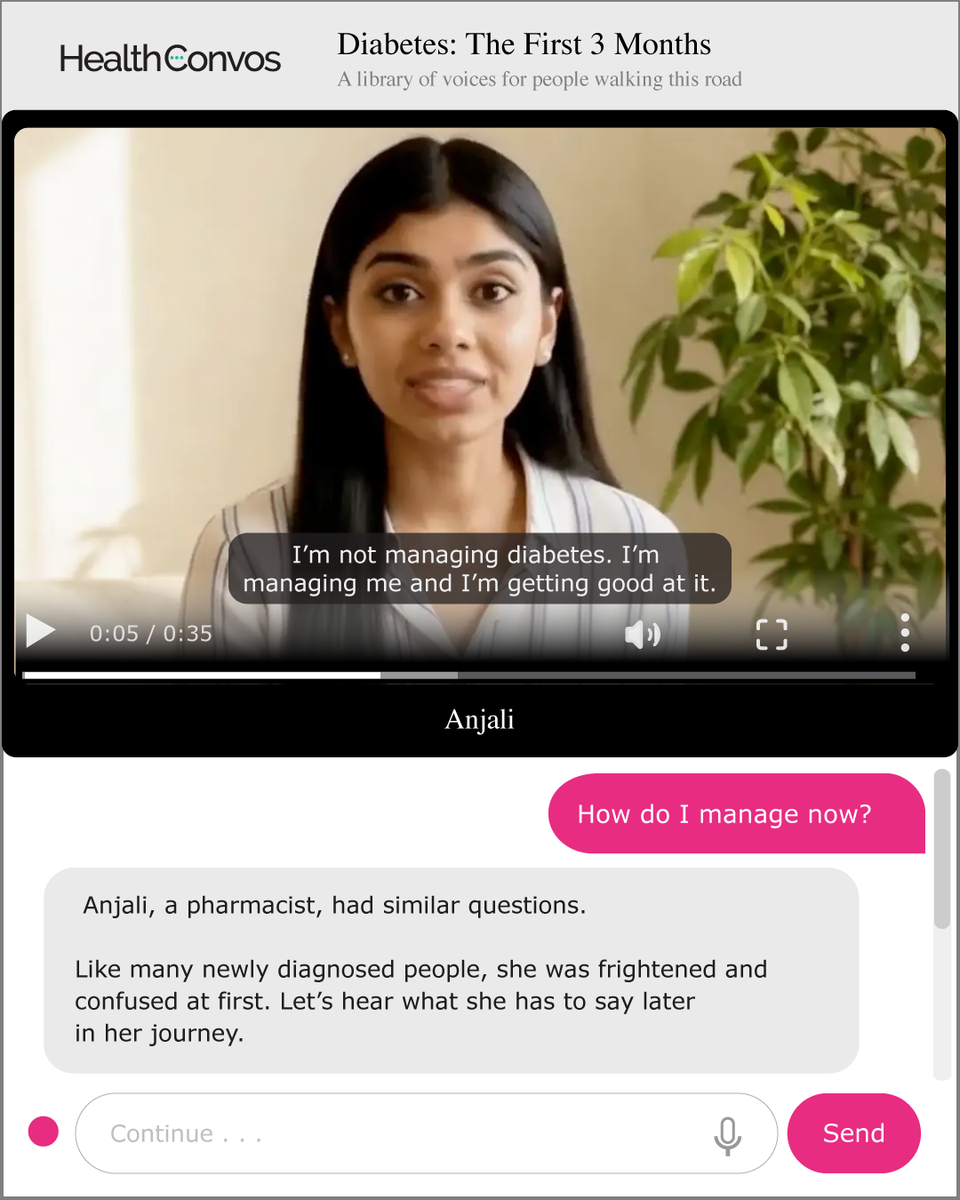
A new channel, not simply a better content library
A conventional patient-education experience asks the patient to navigate someone else's information pathway. Choose a menu item. Find the right page. Watch a full video. Search through a library. Guess which resource answers the concern that feels urgent right now.
A conversational experience reverses that relationship.
The patient asks a question in their own words. The experience identifies the intent of the question and presents a relevant, previously recorded response from a relatable character. The patient can follow the character's journey, moving from diagnosis and uncertainty toward understanding and practical next steps.
The result is not an open-ended medical chatbot. It is a governed library of finite, reviewable patient-facing content delivered in a conversational form.
That distinction matters to agencies and their clients. The experience can feel responsive without composing a new medical answer at the moment of asking. Every patient-facing response has a script, transcript, and caption track. The approved content remains locked until a new response is deliberately created and reviewed.
“MLR-ready” describes how the experience is governed, not why it exists. HealthConvos gives patients a private place to express the fears and concerns behind their questions, then responds with a relevant human story designed to help them feel understood, less alone, and more ready to take an appropriate next step. A finite, inspectable response library makes that experience reviewable through the client’s established process; responsibility for compliance and approval remains with the agency and its client.
Why patient stories belong at the center
Facts are necessary, but patients do not encounter a diagnosis as a collection of facts.
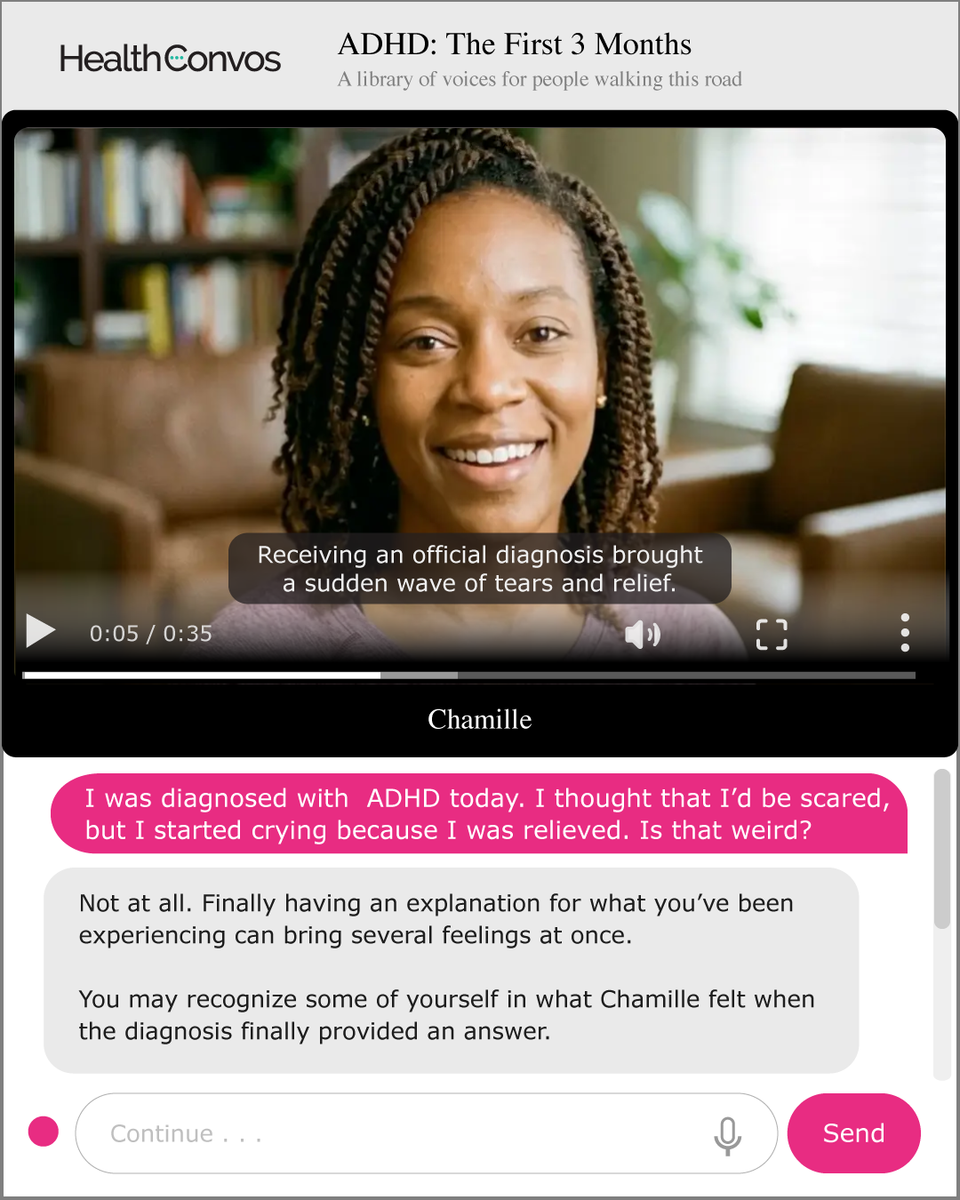
They encounter it through fear, uncertainty, family responsibilities, past experiences, cultural context, and practical barriers. A well-developed character can carry those realities through an entire story arc. Patients can follow the character from the first difficult moment through questions, setbacks, decisions, and progress.
We have seen viewers respond emotionally when a character's experience reflects their own. That recognition can make education feel less abstract: someone else has felt this, asked this, and found a way forward.
Evidence also supports the careful use of narrative and video. A 2026 meta-analysis of 34 randomized trials involving 4,584 participants found that narrative-based interventions may improve self-efficacy and self-management, although results varied considerably among studies. A systematic review of 59 chronic-disease studies found video's most consistent benefit in improved patient knowledge; effects on behavior, healthcare use, and disease severity were less consistent. These findings support the HealthConvos design rationale; they do not substitute for direct evidence of HealthConvos outcomes.
“I thought this was something happening to me and there was nothing I could do. Then I began to see that I still had a role in what happened next.” — HEALTHCONVOS CHARACTER
The agency's patient insight is essential here. Creating a believable journey requires more than writing isolated answers. It requires an understanding of the emotional and practical sequence of the experience—what patients worry about first, what they may not be ready to hear, and what can help them take the next step.
AI-created characters should be disclosed, not disguised
The deeper platform feature is continuity. When a patient recognizes something of themselves in one character, they can keep following that same person through diagnosis, early attempts, setbacks, changing care needs, and the routines that make daily life more manageable. Each response can stand alone, but together the approved clips form a coherent journey.
HealthConvos uses AI-created characters to portray governed patient journeys. They are not real patients or testimonials. Although the characters are generative, their patient-facing scripts are finite, reviewed, and fixed before release.
That disclosure is a governance feature. An AI-generated character gives the agency and client control over the script, representation, clinical content, and complete story arc without attaching a real patient’s identity to a promotional asset that may later require review. It also prevents the viewer from being misled about whose experience is being portrayed.
Generative does not mean arbitrary. Characters should be grounded in patient research, therapeutic understanding, and careful representation. Their function is to make governed education relatable—not to manufacture evidence, imply a typical outcome, or substitute a fictional story for substantiated product claims.
A new way to add value for clients
HealthConvos gives agencies a new patient-engagement channel that can deepen the client relationship by extending their therapeutic, creative, and MLR expertise into an ongoing patient experience.
The agency brings the therapeutic expertise, patient understanding, client context, and regulatory process. It shapes the personas, story arcs, scripts, clinical review, brand expression, and distribution strategy.
HealthConvos supplies the technology and production layer behind the experience. Approved scripts become recorded clips, captions, conversational pathways, hosting, deployment, and aggregate reporting.
The division of labor is straightforward:
The agency determines what patients need to hear and shapes the stories that will support them.
REACHUM turns those approved stories into video, screens and processes patient messages without retaining them, identifies the concern behind each question, and delivers the most relevant governed response—while preserving privacy and reporting only non-identifying aggregate trends.
Together, those capabilities give the client a differentiated, ongoing patient experience—and give the agency a new source of strategic growth across patient engagement, content planning, and metrics.
One governed content investment can keep becoming more useful
Traditional campaign reporting can show whether someone opened, clicked, or completed an experience. Those measures say little about what the patient still needed.
A conversational channel can reveal something more useful: the intent behind the questions patients ask.
HealthConvos processes each submission to identify its intent. The original submission is not stored, and inputs are screened to remove identifying information. Reporting is aggregate, revealing where questions, confusion, or unmet needs are concentrated without building individual marketing profiles.
Those trends guide the next round of governed content. If patients repeatedly ask about a concern the module does not yet address, the agency and client can decide whether to create a new reviewed response. The module becomes more useful through an intentional content process—not through unreviewed generative answers or quiet changes to material that has already cleared review.
For the agency, that creates an ongoing strategic role:
- Develop the initial patient journeys and governed response library.
- Launch the experience through appropriate distribution channels.
- Review aggregate question-intent trends.
- Identify gaps and emerging patient needs.
- Develop and review new content deliberately.
- Expand the experience while preserving governance.
This is more than a one-time content delivery project. It can become a continuing patient-experience and content-strategy program.
Aggregate intent patterns inform deliberate additions to the governed response library; approved responses do not change on the fly.
How the channel keeps improving
- Agency expertiseTherapeutic knowledge, patient insight, and regulatory stewardship.
- Governed patient storiesFinite scripts and recorded responses that can be reviewed before release.
- Conversational distributionPatients begin with the question or concern that matters to them.
- Aggregate intent trendsNon-identifying patterns reveal recurring questions and unmet needs.
- New reviewed contentThe agency and client deliberately expand the governed response library.
Distribution meets patients simply and safely
A HealthConvos experience can be reached through QR codes on provider-distributed materials, links in privacy-appropriate email or SMS messages, embeds in webpages, or links from existing digital resources. A generic entry page can avoid displaying a condition on a patient's lock screen, browser history, or printed card when discretion is important.
The right distribution plan depends on the client, setting, condition, and privacy requirements. The broader point is that conversational patient engagement does not need to be trapped inside a destination patients must remember to visit. It can be placed in the moments and channels where questions actually arise.
What agencies can bring to healthcare clients now
Healthcare clients do not need another technology demonstration detached from their existing content and approval reality. They need a credible way to support patients beyond the clinical encounter.
An agency can bring them a concrete proposition:
- A differentiated patient experience grounded in human stories
- A finite patient-facing response library that can be reviewed before launch
- A conversational channel that begins with the patient's question
- Flexible distribution without requiring an app
- Privacy-preserving, aggregate insight into unmet information needs
- An ongoing roadmap for new governed content
Most importantly, the proposition builds on expertise the agency has already earned.
The agency can turn therapeutic understanding, patient insight, approved assets, and MLR experience into a new value added offering.
A practical place to begin
The strongest first HealthConvos opportunity is usually not “convert everything.” It is a bounded patient journey with a clear audience, meaningful unanswered questions, available subject-matter expertise, and a realistic review path.
Start with one condition or moment of care. Identify the questions patients ask before and after that moment. Define a small group of characters whose journeys reflect the audience without claiming to represent every patient. Map the governed responses required to support those journeys. Then determine how patients will encounter the experience and what aggregate intent trends would be valuable to the client.
That is enough to create something patients can actually use—and enough to show a healthcare client what a new conversational channel makes possible.
Frequently asked questions
Is HealthConvos a generative medical chatbot?
No. The system uses AI to identify the intent of a patient's question, but the patient-facing answer comes from a finite library of previously recorded, governed content. It does not generate a new medical response at the moment of asking.
Can agencies put HealthConvos content through MLR review?
Yes. Each patient-facing response has a script, transcript, and caption track that can be reviewed. “MLR-ready” describes that finite, inspectable content structure. Approval requirements and decisions remain with the agency and its client; HealthConvos does not guarantee regulatory approval.
Are the HealthConvos characters real patients?
No. HealthConvos uses AI-created characters to portray governed patient journeys. They are not real patients or testimonials, and their stories should not imply unsubstantiated or typical outcomes. Their patient-facing scripts are finite, reviewed, and fixed before release.
How can patients access a HealthConvos module?
Depending on the client's privacy and distribution requirements, modules can be reached through QR codes, links in email or SMS, embedded webpages, or links from existing digital properties. Patients do not need to install an app.
What patient data does HealthConvos report?
HealthConvos reports aggregate question-intent trends. Patient submissions are processed but not stored, inputs are screened for identifying information, and the system does not create individual marketing profiles.