
A longtime leader in medical education underwent a root canal with sedation. Later, she could not remember the aftercare instructions. She was not sure they had ever been given.
She subsequently cracked the tooth and needed an implant costing approximately $12,000.
Her account does not establish exactly what happened during the appointment or whether different communication would have prevented the outcome. It does expose a familiar weakness: the person leaving a clinical encounter may be in no condition to absorb everything that matters afterward.
Professional expertise does not remove that vulnerability. Neither does a signature confirming that instructions were received.
For health systems, the practical question is straightforward: when the patient is home and ready to understand, how easily can they find the explanation they need?
The encounter ends before the questions do
A diagnosis can consume a patient's attention. A procedure can leave someone tired, uncomfortable, or recovering from sedation. Instructions compete with everything else happening in that moment.
Hours later, a practical question surfaces. The patient remembers part of the conversation, perhaps a warning without its context. A caregiver who was not present needs to understand what comes next.
The health system may have supplied the information. The patient may still be unable to use it.
AHRQ recommends teach-back to check whether an explanation was understood: patients describe the plan in their own words, giving the care team an opportunity to clarify. The responsibility is on the quality of the explanation, rather than on testing the patient. AHRQ's teach-back guidance
That conversation matters. So does what remains available afterward. Health systems should design patient education around the likelihood that people will need an explanation again.
Make the explanation easy to revisit
Printed instructions have an essential place. They provide a reference patients can keep, annotate, and share. But a packet alone asks the patient to locate the relevant passage, interpret it, and connect it to the question now on their mind.
A short video can provide another way in. Patients can hear the explanation, see a demonstration where appropriate, pause, replay, and return with a caregiver.
Research supports a measured case for video. A systematic review of 15 randomized trials involving 2,454 adults found that 11 studies reported better recall with animated videos than with usual information delivery. Most assessed recall immediately; evidence about longer-term retention was more limited. These findings concern animated educational videos, not HealthConvos specifically. Health information recall review
Video deserves a place alongside written information and human explanation. A video view, by itself, does not demonstrate understanding.
For the patient at home, access is as important as format. An excellent explanation has little value if finding it requires remembering a clinical term, searching through a large library, or navigating an unfamiliar login.
The experience should begin with the question the patient can actually express.
Multiple languages multiply the work
Across a large health system, the same explanation may need to serve patients who speak different languages and have different hearing, vision, reading, or digital-access needs.
HHS identifies language assistance and services for people who are deaf or hard of hearing as important components of effective healthcare communication. HHS communication guidance
For patient education, a language count tells only part of the story. The organization needs to know whether the explanation is clear, accurate, accessible, and current in each version.
That means reviewing the script, spoken delivery, captions, transcript, and directions for getting further help. When instructions change, every affected version needs an owner and a review process.
Video can support that work when it is developed as a complete, reviewed resource. It should remain connected to interpreters, accessible alternatives, and the care team whenever those are needed.
Answer the question that arrives later
HealthConvos gives health systems a way to make reviewed and approved video explanations available through one link or QR code, without requiring a patient account.
The patient initiates the experience with a question in their own words. AI identifies the intent and selects a relevant response from a fixed library of pre-approved videos. It does not compose medical guidance during the conversation.
That distinction gives the organization something concrete to review before release: the actual response a patient will receive.
Patient submissions are processed transiently and are not stored. The organization receives only non-identifying aggregate intent reporting, which can help show where questions recur and where additional approved explanations may be needed.
HealthConvos complements portals, EHRs, prescribed pathways, and formal instructions. Individual treatment decisions and concerns requiring clinical attention remain with the care team.
For organizations evaluating that role, our patient education platform comparison explains how different approaches fit into the same care environment.
Source: Rolnick et al. (2013). One integrated U.S. health system, using 2007–2009 data and a medication possession ratio threshold of 80%. These estimates concern the single-condition, single-medication subgroup (15,334 patients across eight conditions). The study excluded some early discontinuers. The figures do not establish why adherence was low or what share education could improve.
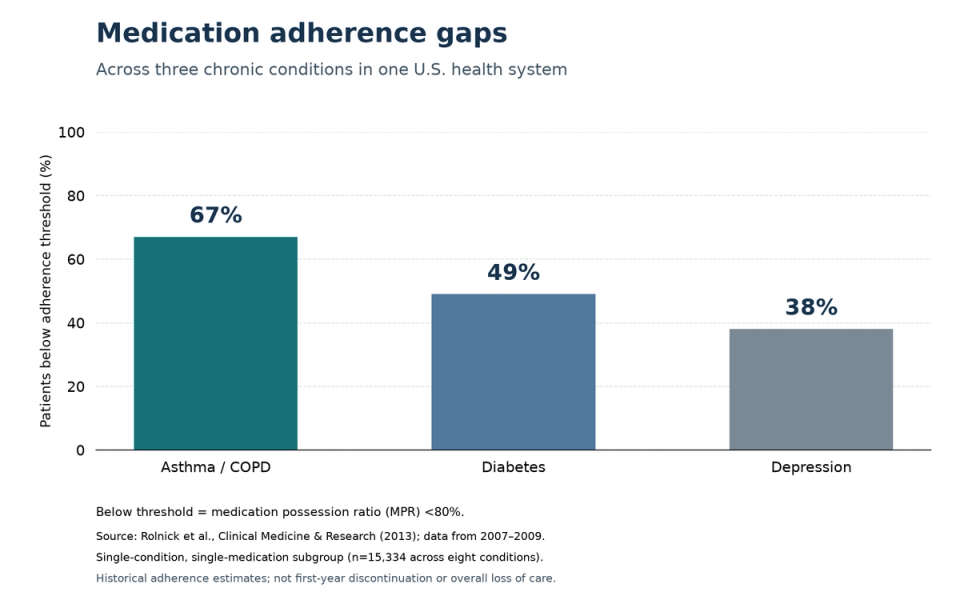
Start where patients are falling away
A useful first deployment begins where the health system sees missed follow-up, difficulty following a medication plan, incomplete preparation, or another break in care.
Many patients never voice the question behind that behavior. They may be embarrassed, unsure what to ask, or unaware that they have misunderstood. An absence of questions does not establish understanding.
Patients may understand the instructions yet still struggle to accept the diagnosis those instructions address. Education needs to make room for that uncertainty. Instructions can be missed, forgotten, misunderstood, or difficult to accept; silence does not reveal which barrier a patient faces.
Choose one transition where follow-through is a documented problem. Give patients an easy, private way to ask what is on their mind and receive reviewed, approved video explanations in the languages they need.
Evaluate whether that support helps patients take the intended next step. The health system should establish a baseline and measure follow-up, adherence, or preparation through its own clinical systems. HealthConvos's non-identifying aggregate intent reporting can reveal areas of uncertainty, but it cannot establish individual patient outcomes.
The aim is to improve follow-through. Video views show use; the evaluation must determine whether that use contributes to better care.
The $12,000 dental experience is one person's account, not an estimate of savings from video or evidence that a platform would have prevented the outcome. It is a reason to examine an assumption: that information delivered during an encounter will still be available in the patient's memory when it is needed.
Health systems can make that assumption less consequential by giving patients a reliable way to return to the explanation.
Explore the health-system business case for patient education. Start with a break in follow-through, then learn what patients need to understand to take the next step.
Reporting note: The opening account was shared with HealthConvos and is described anonymously. The approximate cost is reported by the individual; it has not been independently audited. The hero image is AI-generated and does not depict the person in the account.