
A proposed, product-neutral standard for authentic and accountable synthetic representation in healthcare
Synthetic actors can protect privacy while helping people hear experiences that matter. But trust depends on a distinction the industry has too often blurred: a believable portrayal is not necessarily direct personal testimony, and a synthetic performance does not turn a researched script into a lived experience.
The actor can be synthetic. The provenance cannot be vague. A responsible system must tell audiences what kind of narrative they are seeing, what evidence supports it, how it was reviewed, and who is accountable.
The goal is not to make every healthcare story look “real.” It is to protect the experiences and voices of real people—and to be equally honest when a story is a composite, an interpretation, or an illustrative fiction.
That is the premise of this proposed synthetic-actor authenticity and representation standard: protect the person, preserve the meaning, disclose the provenance, and govern the result.
Why we say “people,” not “patients”
Healthcare organizations naturally use the word “patient.” It is accurate within a clinical relationship, but it can become reductive when it is treated as a person’s identity.
Someone diagnosed with stage IV cancer is still a parent, colleague, neighbor, artist, engineer, caregiver, or friend. They may receive care as a patient, but they do not necessarily want to be defined by that role.
“Patient” describes a relationship to a healthcare system. “Person” recognizes the whole human being.
That is why this standard uses “people” whenever human identity is at stake. The choice is deliberate even in a healthcare setting. Respect for lived experience begins with refusing to reduce a person to a diagnosis.
The provenance problem predates generative AI
Much of what brands receive from agencies as a “patient story” is not direct personal testimony. An agency copywriter may interview several people, review patient advisory-board findings, study a brand’s journey research, and then create a composite narrative that expresses recurring themes. In other cases, research insights are shaped into the brand’s rendition of a journey without tracing every line to a documented source statement.
That work can be useful and responsible. Composite writing can protect privacy, make recurring needs legible, and create a coherent educational experience. The ethical failure occurs when a composite or invented scenario is presented with the authority of an identifiable person’s literal testimony.
Generative AI raises the stakes because a photorealistic actor, natural voice, and emotionally precise script can collapse distinctions that were once easier to see. A viewer may reasonably infer, “This happened to the person I am watching,” even when the narrative was assembled from research or written to illustrate a plausible situation. Disclosure therefore has to describe not only the synthetic actor but also the provenance of the script.
The MEDVi controversy shows what can go wrong
Reporting in April 2026 about telehealth company MEDVi illustrates the danger when synthetic media, medical authority, testimonials, and affiliate marketing blur together. Business Insider reported that affiliate ads promoting MEDVi appeared under physician identities that could not readily be verified and showed signs of AI generation; related reporting described purported medical personas, AI-generated models, and altered imagery used to support promotional messages.
These were reported allegations and observations, not a finding that every MEDVi advertisement was produced or approved directly by MEDVi. In its official response, MEDVi said it had become aware of advertisements featuring potentially AI-generated medical practitioners, updated its marketing practices to prohibit such advertising, and disputed how an FDA letter tied to medvi.io had been characterized, saying that site belonged to an affiliate rather than MEDVi’s medvi.org domain.
The episode’s larger lesson is product-neutral: outsourcing production or distribution does not eliminate the need for controls. Agencies, affiliates, platforms, creators, and automated tools can multiply reach—and ambiguity. A named organization must be able to verify identity, source, claims, disclosure, approvals, and downstream use.
The Federal Trade Commission’s guidance draws a useful line. Its Consumer Reviews and Testimonials Rule does not impose a blanket ban on actors or AI avatars. But an underlying testimonial may not be fake or false, and a synthetic portrayal can still be deceptive under the FTC Act if the presentation causes reasonable viewers to believe something untrue. A synthetic actor is not a loophole.
Four provenance classifications audiences can understand
A workable standard should classify the narrative separately from the actor. Every item should carry one of four labels, expressed in audience-friendly language and backed by more detailed records:
1. Documented direct testimony
The account is grounded in the documented words or experience of one real person. Editing may improve clarity, length, translation, or accessibility, but it must preserve meaning. The record should identify the source, consent scope, material edits, reviewer approvals, and version.
Suggested disclosure: “Based on one person’s documented experience; performed by an AI-generated actor.”
2. Research-based composite
The narrative combines documented experiences or recurring findings from multiple people, such as interviews, advisory boards, or qualitative research. No single person said or experienced the entire script. The record should identify the source library, inclusion criteria, synthesis method, privacy controls, and reviewer approvals.
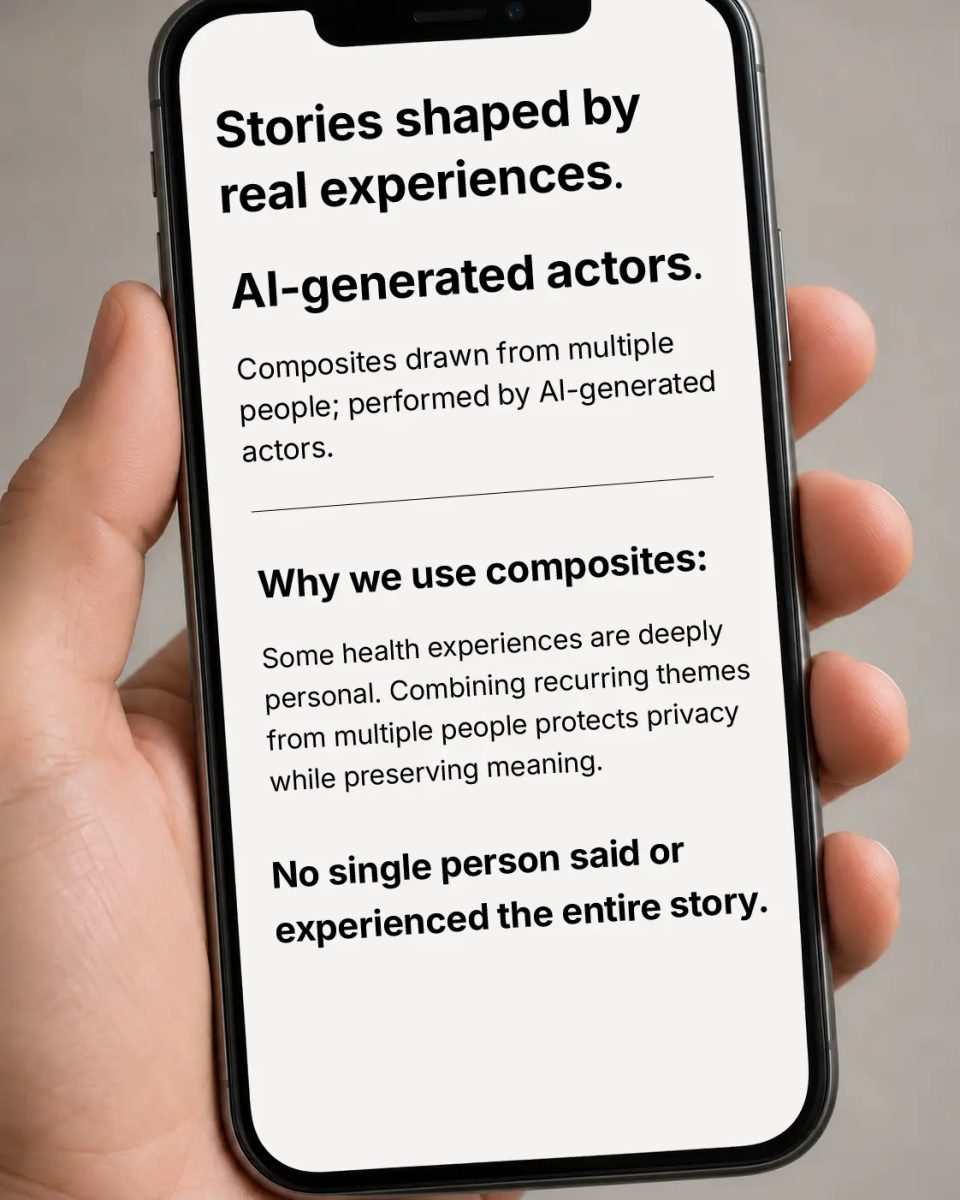
Suggested disclosure: “A composite drawn from multiple people; performed by an AI-generated actor.”
3. Insight-informed fictionalized narrative
The script is fictionalized, but it is shaped by documented themes from research, journey analysis, aggregate questions, or observed informational and emotional needs. Individual sentences may not map to source testimony.
Suggested disclosure: “A fictionalized narrative informed by research insights; performed by an AI-generated actor.”
4. Illustrative fictional scenario
The scenario is created to explain a possibility, decision, or educational concept and is not represented as testimony or as the synthesis of a specific evidence base.
Suggested disclosure: “An illustrative fictional scenario; performed by an AI-generated actor.”
These classifications are not a quality ranking. A carefully reviewed fictional scenario can be more useful than a poorly edited testimonial. The point is epistemic honesty: the audience should understand what relationship the story has to real people and evidence.
Classification must be dynamic, not merely a single label applied to an entire platform. Each video, script, language version, and source library should carry metadata for its provenance class, source set or library, collection period, consent basis, material adaptations, editorial and clinical reviewers, promotional status, model or production method, publisher, version, and correction history.
If a script changes enough to cross a category boundary, its classification and disclosure must change too. The change also triggers a new editorial and clinical review before republication; approval of the earlier version does not carry over.
The proposed standard

Provenance before performance
The source category should be determined and documented before a synthetic actor renders the script. Production teams should not infer provenance after the fact from polished copy. Direct testimony requires a protected audit trail to the underlying account; composites require a defined synthesis method; insight-informed fiction requires a named evidence base; illustrative fiction must never borrow the aura of testimony.
Truthfulness and faithful meaning
Editing must not convert uncertainty into certainty, a question into an endorsement, a mixed outcome into success, or a general concern into a product claim. Quotations should be reserved for words that can be substantiated as quotations. First-person language deserves special care because it naturally suggests lived experience.
Clinical and editorial review
Clinical review should assess medical accuracy, context, omissions, and safety implications. Editorial review should assess fidelity to the provenance class, plain-language clarity, accessibility, and the risk of overclaiming through tone or imagery. Reviewers should have authority to revise, reject, pause, or withdraw content, and their approvals should be version-specific.
Privacy and consent by design
Synthetic actors should reduce exposure, not create a new path to re-identification. Consent should cover intended uses, meaningful adaptation, translation, distribution, retention, and correction or withdrawal procedures. Direct identifiers must be removed, and distinctive combinations of clinical, demographic, geographic, and temporal details should be reviewed for re-identification risk. For classes 1 and 2, that review is documented before the script is rendered (Appendix 2).
Using a synthetic actor does not de-identify the underlying account, and this standard makes no claim that it does. Where source material is protected health information, HIPAA obligations continue to apply to it. Aggregate research must use appropriate access controls and minimum-necessary detail.
Promotional claims remain promotional claims
Authentic experience is not clinical evidence. A real person’s account does not establish that a treatment is safe, effective, or appropriate for others. When content promotes a regulated product, applicable FDA requirements still govern: prescription-drug promotion must be truthful, balanced, accurately communicated, appropriately substantiated, and not misleading, with required risk information and material facts presented as the context demands. FTC endorsement and testimonial principles may also apply. Provenance disclosure supplements these duties; it does not replace them.
Audience-friendly disclosure
The essential disclosure should appear where people encounter the content, in language they can understand, with enough prominence, duration, contrast, and proximity to be noticed. Legal detail can sit one layer deeper, but the core fact cannot be buried in a footer, terms page, or generic “AI may be used” statement. The disclosure should name both dimensions: what the actor is and what the narrative is.
Accountable human governance
A named organization—and named roles within it—must own the decision to publish. Governance should include documented review thresholds, conflict escalation, agency and affiliate controls, version management, monitoring, complaint handling, correction, and withdrawal. Humans cannot be reduced to ceremonial approvers of an automated pipeline. They must have access to the evidence and real authority over the outcome.
A feedback loop that improves representation without manufacturing testimony
HealthConvos sees a meaningful opportunity in the aggregate questions people ask, the information they cannot find, and the emotional concerns that recur across conversations. Over time, those signals can reveal where scripts are confusing, incomplete, overly clinical, or out of step with what people actually need to discuss.
Used responsibly, this creates an ongoing feedback loop: observe aggregate patterns; identify unmet informational and emotional needs; propose script changes; review them editorially and clinically; reclassify provenance if the nature of the script changes; publish a new version; and continue monitoring.
The loop requires restraint. These observations are not a representative population sample by default. People who encounter or choose to use a particular service may differ from those who do not, and conversational data can reflect channel, campaign, language, access, and self-selection effects. Aggregate patterns should therefore be treated as directional evidence, not prevalence estimates or clinical findings, unless a study design supports stronger claims.
Most importantly, iterative improvement does not transform AI-written lines into literal real testimony. A script may become more responsive to real questions and more faithful to observed concerns, yet remain an insight-informed fictionalized narrative or a research-based composite. Better representation is not the same as direct testimony, and the label must preserve that distinction.
How HealthConvos is applying the idea
The standard proposed here is open and product-neutral. Any healthcare publisher, agency, platform, manufacturer, advocacy group, or research organization should be able to use, critique, and improve it. It has not been adopted by a standards body, certified by a regulator, or validated as a compliance safe harbor.
HealthConvos’ commercial implementation is one practical expression of the proposal. Before any video plays, its entry screen presents a persistent, non-disruptive statement: “Composites drawn from multiple people; performed by AI-generated actors.” After a person continues, the experience presents a 720×900 captioned video. The experience has no disclosure overlay and no consent gate. People can begin normally. The entry-screen statement must be true of every conversation it appears on. Where a library mixes provenance classes, it describes the least-documented class, and the conversation’s own classification appears beside it.
An adjacent information button provides optional detail for anyone who wants it. That explanation can describe how dialogue was sourced, edited, and represented without forcing every viewer through a modal. This layered design puts the essential fact in plain sight while keeping deeper context available.
As the provenance framework expands, the same interface can surface the applicable classification for each conversation—for example, documented direct testimony or research-based composite—and retrieve dynamic metadata for the particular source library and version. HealthConvos should be judged by the same standard it proposes: accurate classification, substantiated claims, transparent limitations, protected privacy, and accountable review.
A standard built for trust
The meaningful divide is not “real people versus AI.” It is accurate representation versus fabrication, and disclosed synthesis versus ambiguity.
A trustworthy synthetic portrayal tells people what they are seeing, what kind of evidence sits behind the narrative, what was changed, and who stands behind it. It protects privacy without borrowing the false authority of literal testimony. It separates human experience from clinical proof. It keeps agencies, affiliates, publishers, and technology providers inside the chain of accountability.
The experiences and voices of real people deserve protection. So does the audience’s right to understand when a story is direct testimony, a composite, an insight-informed fiction, or an illustrative scenario. Synthetic actors can carry those forms responsibly—but only when provenance travels with the performance.
Sources
- Federal Trade Commission, “The Consumer Reviews and Testimonials Rule: Questions and Answers”
- Federal Trade Commission, “Federal Trade Commission Announces Final Rule Banning Fake Reviews and Testimonials”
- U.S. Food and Drug Administration, “Prescription Drug Advertising and Promotional Labeling”
- U.S. Food and Drug Administration, “Recognizing and Reporting Potentially False or Misleading Prescription Drug Promotion”
- MEDVi, “Official Communication,” April 8, 2026
- Business Insider report republished by Yahoo Finance, “Medvi, the AI-powered telehealth company, is fueled by ads from doctors who don’t appear to exist,” April 7, 2026
- Coalition for Content Provenance and Authenticity, “C2PA Specifications”
- Coalition for Content Provenance and Authenticity, “C2PA and Content Credentials Explainer”