Transcript
Okay. Let's dive right into this explainer and unpack the fascinating mechanics behind HealthConvos. If you've been tracking healthcare tech lately, you know there is this massive, almost constant tension, right?
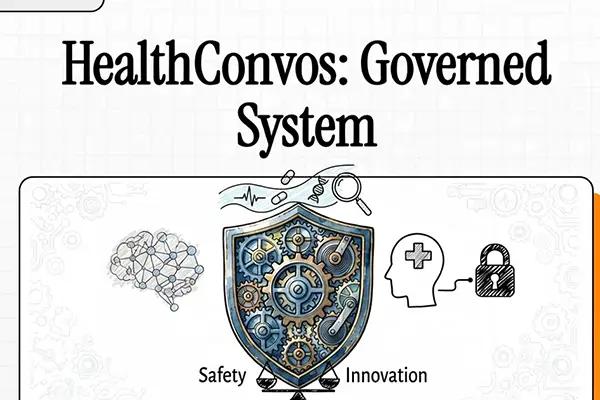
On one hand, everyone wants to use advanced AI for patient communication, but on the other hand, you absolutely cannot compromise on medical safety or patient privacy. So today, we're going to see exactly how HealthConvos uses AI across a multi-step governed orchestration process to actually resolve patient question ambiguity, all while validating safety rules and generating insights without ever storing a transcript. It's a really clever system, so let's just get right to it.
The true magic of this platform really comes down to the sheer contrast between the surface experience and the backend reality. For a patient, the whole thing just feels like asking a single private question. Simple, right?
But beneath the surface, the system is quietly launching this massive 12-plus step orchestration of checks and activities. It's an incredible bit of sleight of hand. The experience stays entirely human and frictionless, while all the heavy lifting and complex decision-making stays completely behind the scenes.
To really understand this hidden architecture, we're going to follow a single question through five crucial stages. Simple for the patient, resolving ambiguity with AI, enforcing medical safety rules, delivering approved patient education, and finally, aggregate insights without transcripts. Starting with stage one, simple for the patient, the private entry point.
The whole process kicks off with a simple QR code scan. There are no logins, no tracking cookies, just immediate, completely frictionless access. The absolute most crucial point here is exactly how that input is handled.
HealthConvos guarantees they don't collect personal information. If a patient decides to speak into their phone, that microphone speech is transcribed locally, right there by their own web browser. The system literally never even receives an audio file.
The question is entirely temporary. It exists just long enough to get an answer in the moment, and then it vanishes. That ensures absolute ironclad privacy from the very first second of the interaction.
Now, to truly appreciate what happens next, we kind of need to reset our expectations. This is absolutely not a chatbot. It is a governed decision system.
A standard chatbot just generates text back and forth, guessing what sounds right. But this system, it's a highly coordinated architecture that executes more than a dozen deterministic decisions, safety checks, and actions for every single turn of the conversation. It is doing an enormous amount of work in the background, precisely so things stay simple and safe for the patient.
Which brings us to stage two, resolving ambiguity with AI, understanding intent. This is where the probabilistic power of AI actually comes into play to interpret unstructured, often messy human language. Rather than just acting like a basic search engine that scans for keywords, the AI goes so much deeper.
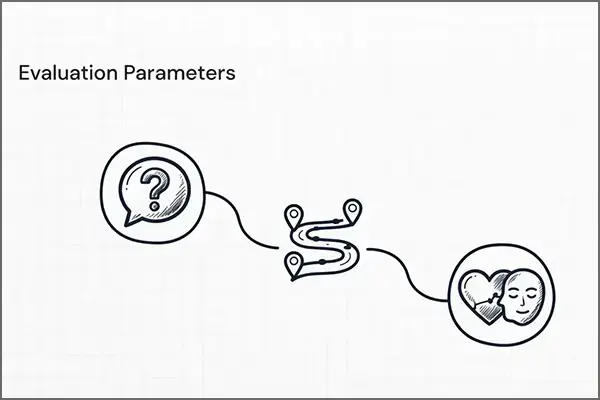
It acts probabilistically to evaluate three distinct dimensions of the patient's actual words. It evaluates the topic, sure, but it also considers the specific stage of the patient's journey, and critically, the emotional context behind what they're asking. It's really trying to figure out what the person is actually asking for, not just parsing the medical jargon they happen to use.
And this is where it gets really smart. When the AI evaluates the approved library, it prioritizes matching the patient's emotion first, before just settling for a topical match. It is genuinely aiming for empathetic understanding.
Because think about it, someone who is terrified about a brand new diagnosis needs a vastly different educational approach than someone who is just asking a basic logistical question about that exact same condition. Moving right along to stage three, enforcing medical safety rules, the deterministic safeguards. Here, we cross the line from the probabilistic world of AI into a highly governed, strictly deterministic environment.
This flow shows exactly how the system aggressively filters the AI selection. First, it understands and matches. That's the AI part.
But then, bam, it immediately moves to protect, applying rigorous session safeguards, and then verify, confirming the approved status of the content. It's an independent, hardcoded verification process that ensures medical accuracy is the absolute top priority. Let me give you a perfect example of that protect step in action.
The rule to route clinical questions to the care team. The system is explicitly programmed to recognize medical questions and draw a hard line. This completely prevents the AI from hallucinating medical advice and keeps the digital companion strictly within its defined lane of patient education.
It doesn't guess. No way. It escalates to human experts when necessary.
So the AI chooses, but the deterministic system verifies. The software independently validates that any selected story is real, partner-approved, relevant to the context, and importantly, hasn't already been viewed by that specific patient. Because of this rigid governed boundary, an answer is literally never invented or generated on the fly.
Okay, stage four, delivering approved patient education, the final experience. Let's look at the result of those dozen-plus background checks we just talked about. Almost instantly after asking their question, the patient receives this incredibly seamless, human-feeling experience.
The system streams a short captioned video featuring the healthcare partner's approved branding. And crucially, it also ensures that every single safely verified next question leads only to another appropriate unplayed story. The patient gets a perfectly smooth journey, completely oblivious to the massive verification marathon that just occurred in milliseconds.
And here is a truly surprising fact. This entire governed orchestration, from resolving ambiguity to verifying safety, all the way to streaming the captioned video, it costs healthcare partners just 15 cents per minute. That is a staggering amount of heavy lifting for literal pennies.
Finally, stage five, aggregate insights without transcripts, data-driven improvements. How on earth do we learn from this data without violating privacy? It's a really fascinating paradox to solve.
Well, the impact of strict privacy is actually immediate. When patients are explicitly assured that transcripts aren't stored and audio isn't collected, engagement shoots up. Daily sessions for diabetes rose 19% and ADHD 22%.
But look at the most sensitive module. herpes sessions increased by a massive 400%. The system proves that people will absolutely engage with difficult, sensitive questions, provided they know for a fact that the privacy boundary is rock solid.
So the platform delivers this beautiful dual value. For the patient, they get relevant, approved stories, never an invented answer, all from a private, temporary question. And for the healthcare partner, they receive aggregated signals about intent, match quality, unmet needs, and content gaps.
And they get all of that without storing a single question transcript. It's a total win-win. By measuring these structured aggregated signals, the system essentially builds a continuous data-driven roadmap.
Healthcare partners can see what actually matters by understanding the recurring themes patients are bringing up. And equally important, they can see exactly what is missing. They can pinpoint precisely where the current approved library is falling short and where new educational stories need to be created.
As we wrap up this explainer, I want you to think about your own organization's educational outreach. Where are your hidden patient education gaps? When you see how seamlessly a governed decision system can use AI to resolve patient ambiguity, all while rigidly enforcing medical safety and absolute privacy, it really does change the standard for what's possible in healthcare.